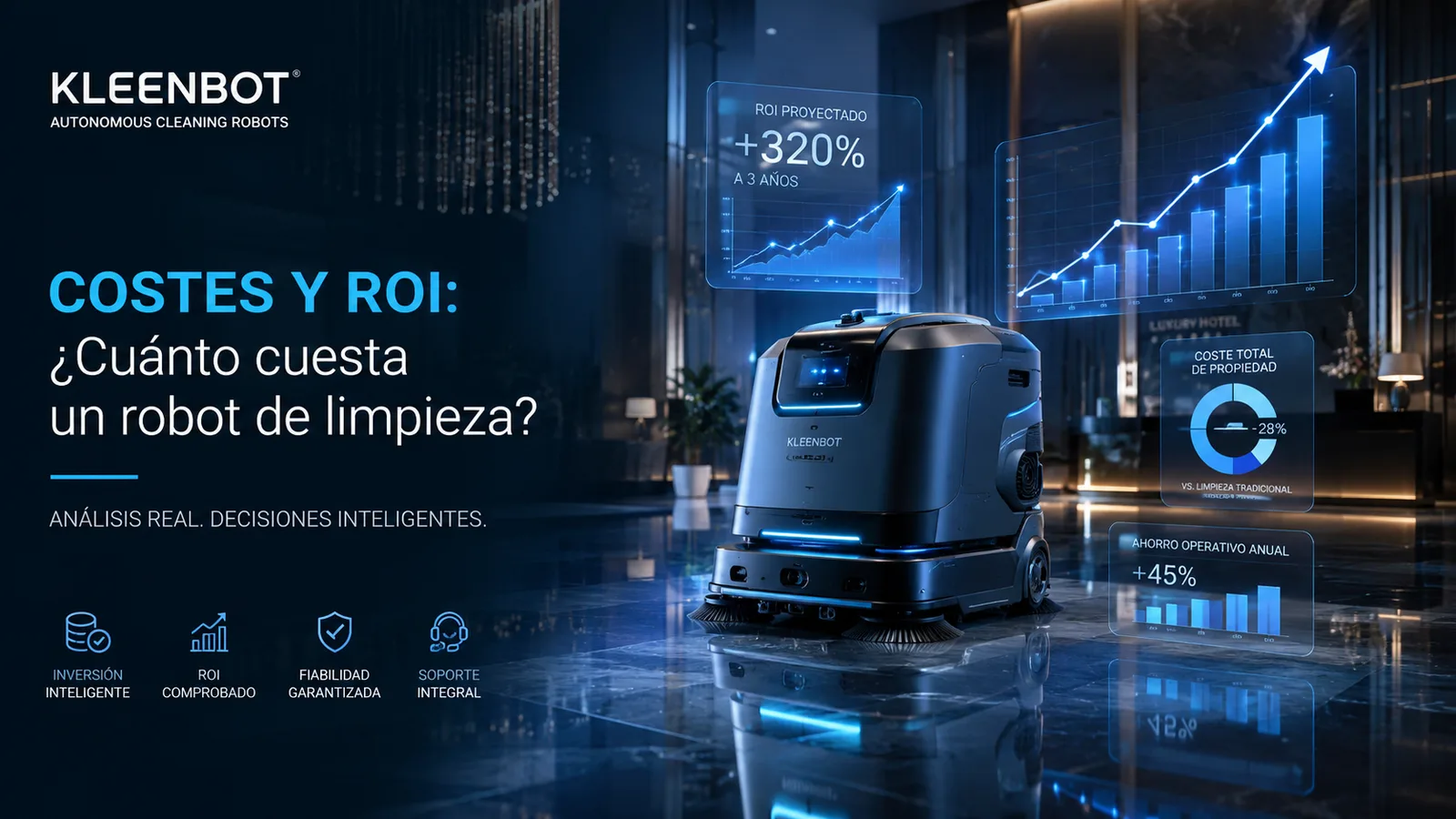
When a hotel chain, a shopping centre or a facility manager asks how much an autonomous cleaning robot costs, the right answer shouldn't start with the purchase price. The important figure is the total cost of operation: how much cleaning costs today, how many repetitive hours the team spends, which areas are cleaned most often and how much value is created by freeing staff for more judgement-based tasks.
A robot like the KLEENBOT isn't deployed to replace an entire operation but to absorb the most repetitive routes: corridors, common areas, lobbies, open surfaces, supermarket aisles, hospitals or logistics areas. That's why the price must be analysed alongside the number of square metres, shifts, cleaning frequency and real labour cost.
Indicative price of the main KEENON cleaning robot models
The amounts below take each model's base list price as a reference. They're a good reference for understanding the real starting point, but they shouldn't be confused with a turnkey proposal: the final price depends on configuration, accessories, consumables, charging station, software, installation, support and the specific needs of the facility. For a firm offer it's best to request a quote with an operational assessment.
| Model | Recommended use | Indicative base price |
|---|---|---|
| KLEENBOT C30 | Small and medium surfaces | From €8,900 + VAT |
| KLEENBOT C40 | Hotels, hospitals and large facilities | From €12,500 + VAT |
| KLEENBOT C55 | High power and very large surfaces | From €18,900 + VAT |
Important: these amounts are indicative base prices for the equipment. They do not include VAT, transport, installation, mapping, training, accessories, Work Station, consumables, technical service or any configurations specific to each facility.
Hidden costs no one tells you about before buying
Installation and initial mapping
The robot needs to learn the environment, set up zones, routes, charging points and restrictions. This work is key: a good map avoids incidents and improves productivity from day one.
Team training
Staff must learn to send tasks, change consumables, check alerts and coordinate the robot with daily operations. Training reduces internal friction and prevents the robot from ending up underused.
Annual preventive maintenance
Brushes, squeegees, filters, sensors and tanks need checking. A well-defined preventive maintenance plan protects the investment and avoids unnecessary downtime in peak season.
Software updates
Navigation, maps and fleet management evolve. Having local support helps maintain performance and adapt routes when the layout of the space changes.
Calculate the ROI for your specific facility
Enter surface area, shifts and labour cost to estimate savings, payback and hours freed up before deciding.
Calculate the ROI for your specific facility →How to calculate the real ROI over 3 years
Let's imagine a 150-room hotel with three common-area cleaning shifts. If each shift spends two hours a day on repetitive routes, that's six hours a day. At 22 operating days a month, that's 132 hours a month. With a total labour cost of €16 an hour, the associated monthly cost exceeds €2,100.
If the robot absorbs 60% of that repetitive load, it frees up about 79 hours a month. Over a year that's almost 950 hours the team can devote to supervision, detail cleaning, rooms, incidents or attending to quality standards. These are freed hours to reassign: they only become payroll savings if the organisation reduces contracted hours or avoids new hires. The direct saving isn't the only variable: omissions are reduced, consistency improves and a constant standard can be maintained in low-availability slots.
Over a three-year horizon, compare the upfront investment, maintenance, consumables and electricity against the labour cost avoided or reassigned. The ROI will be higher the larger the surface area, the more frequent the cleaning and the more repetitive the routes.
When does the robot start to pay off?
The payback period is the time it takes for the accumulated saving to equal the investment. Taking a C40 from €12,500 + VAT as a reference and adding deployment, training, accessories and support, the real project is usually analysed as a full investment above the base price. If the operation frees up between €1,200 and €1,500 net a month between reassigned hours and operational improvements, the return can be around 12 to 18 months, depending on shifts, surface area and frequency of use. In facilities with more shifts or larger surfaces, the payback can be shorter.
The key is not to buy from a catalogue. First the flow is validated: metres, schedules, floors, water points, foot traffic, lifts where applicable and the team's capacity to integrate the robot into their routine.
Want a tailored quote for your hotel?
Request a free assessment and we'll tell you the recommended model, estimated cost and expected return.
Request a free assessment