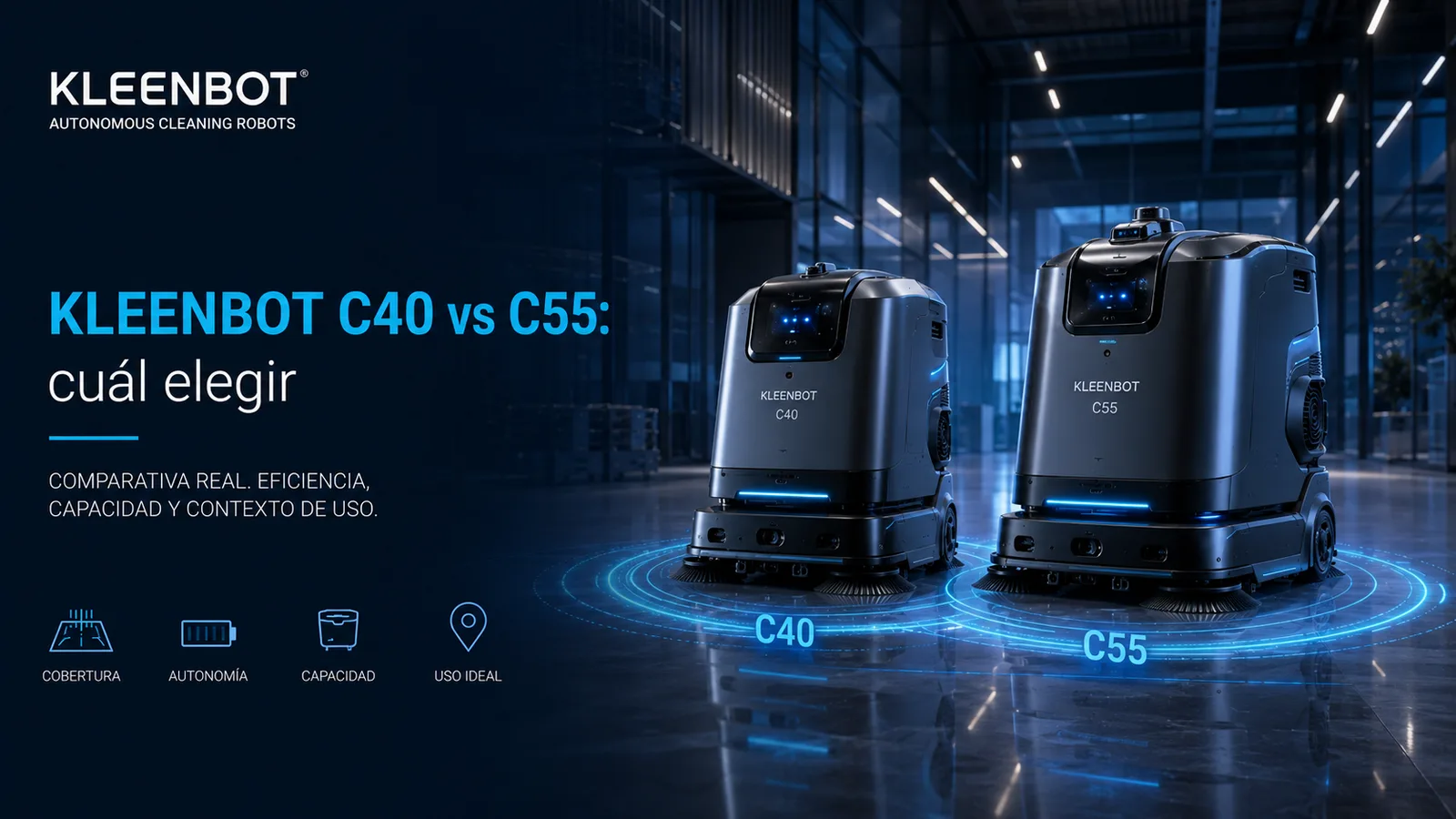
Not all cleaning robots are compared the same way
Comparing cleaning robots on price alone is a common mistake. In hotels, hospitals and shopping centres, the real difference lies in navigation, local support, ease of maintenance and the ability to fit into existing routines. This guide does not publish a table with other manufacturers' models: third-party data changes and is only comparable when it comes from the current official datasheet and is read with the same unit and conditions. Instead, it sets out the criteria and shows how they read on the KLEENBOT C40, which combines sweeping, vacuuming, scrubbing and dust pushing on hard floors and is designed for medium-sized, high-traffic areas.
Technical criteria: what to compare and in which unit
Performance and floor area. Performance is published in m²/h and is usually a theoretical maximum; the recommended daily floor area is a different figure. The C40 publishes up to 1,100 m²/h and a recommended area of 500 to 4,500 m². Always compare the same figure and ask under which conditions it is measured. Functions and floors. A dry-cleaning unit (sweeping, vacuuming and mopping) does not compete with a scrubber; the C40 is 4-in-1 and includes scrubbing, suitable for marble, tile, vinyl, epoxy or short-pile carpet up to 10 mm. Tanks and battery life. They determine how many cycles run without intervention: the C40 has separate 16 L clean-water and 11 L waste-water tanks, 5 h of scrubbing and 12 h of sweeping, with quick battery swap. Aisle width and dimensions. The C40 needs a 65 cm minimum passage (55 cm body); measure real corridors, doors and lifts. Workstation. If the robot empties waste water and refills water and detergent automatically, the team only supervises; if not, count those hours.
Navigation and safety
The C40 navigates by fusing LiDAR and vision: LiDAR builds and updates the map of the space, and depth cameras help detect low, transparent or moving obstacles, including people. Depending on the environment, the robot slows down, stops or requests intervention; installation validates routes, restricted zones and supervision protocols. Three layers are often confused and worth separating: local navigation (on-board sensors, works without a connection), management connectivity (reports, scheduling and alerts through the manufacturer's platform) and integration with lifts or doors, which depends on each building and is assessed during the diagnosis. No robot guarantees universal compatibility or a total absence of incidents: what reduces incidents is a well-executed mapping and a clear protocol for the team.
Operational criteria: support, training and integration
In daily practice, tank size, noise on night shifts and ease of maintenance determine whether the robot is useful or ends up underused. But what weighs most over three to five years is who does the mapping, how the team is trained, which spare parts and consumables are available locally and what support exists when the building's operation changes. Ask about the service level (at Alpha Robotics, Alpha Care Essential, Pro or Premium), response time and whether a replacement robot is available. And ask for the total cost, not the price: investment or fee, deployment, maintenance, energy, consumables and supervision.
How to compare with other manufacturers without getting it wrong
1) Ask for the current official datasheet of each model and note the date. 2) Compare the same metric in the same unit: m²/h with m²/h, tank litres with litres, battery hours per function. 3) Separate the theoretical maximum from practical performance on your floor and with your obstacles. 4) Check the admitted floor types and the aisle width. 5) Insist on a demo in your property, with your routes and your schedules. 6) Value local support, spare parts and training as part of the price. 7) Calculate the 3–5 year total cost with the same method for every candidate; the ROI guide and the configurator help you do it with visible assumptions.
What an integrator adds
Buying the robot is only part of the project. Alpha Robotics acts as KEENON's authorised distributor and integrator in Spain: prior assessment, mapping, team training, local support and pilot follow-up, so that deployment is operational and not just technological.
Conclusion
No robot should be analysed as an isolated machine, but as a tool to cut repetitive hours and stabilise the cleaning standard. The best comparison is the one that crosses, with the same units and conditions, real performance, functions, tanks, navigation, support and total cost. With those criteria on the table, the C40 is a clear reference for medium and large hotels.
Want to apply this in your facility?
Request a free assessment and we'll review the surface area, shifts, priority areas and recommended first robot with you.
Request a free assessmentFrequently asked questions
What sets the KEENON C40 apart from other cleaning robots?
Navigation (LiDAR and vision) and safety, tank capacity and battery life, and above all the local support, spare parts and warranty of an authorised distributor, plus the renting (RaaS) option.
How do you compare autonomous cleaning robots?
It's worth looking at the area per shift, the floor type, navigation and safety, the tanks and battery life, noise, support and spare parts, and the total cost (purchase vs RaaS), not just the initial price.
Is the C40 worth it compared to cheaper options?
The total cost over 3-5 years (reliability, support, spare parts and payback) usually matters more than the purchase price. A cheaper unit without local support can end up costing more. It's worth comparing with your real figures.